
What Our Customers Are Saying
Control Flexibility Redefined: EBM Papst CN1132 Auto/Hand/Off I/O Module for AHU Systems
21
Oct
Control Flexibility Redefined: EBM Papst CN1132 Auto/Hand/Off I/O Module for AHU Systems
October 21, 2025
In HVAC control systems, particularly in Air Handling Units (AHUs), the ability to seamlessly switch between automatic, manual, and off modes is critical for safe operation, commissioning, maintenance, and emergency override. The EBM Papst CN1132 Auto/Hand/Off I/O Module is designed to meet this exact need — providing a smart, low-voltage interface that integrates directly with the EBM Papst MMCU (Modbus Monitoring & Control Unit).
In this blog, we explore the CN1132 in depth, unpacking its functions, benefits, and specific value in AHU applications.
Table of Contents
- What is the CN1132 Auto/Hand/Off I/O Module?
- Product Benefits at a Glance
- Key Applications in AHU Control
- How It Works
- Video Demonstration Highlights
- Why Choose the CN1132 Over Competitor Options?
- Who Should Use the CN1132?
- Installation Tips
- Order the CN1132 from iACS
- Conclusion: Simplicity Meets Smart Control
What is the CN1132 Auto/Hand/Off I/O Module?
The CN1132 is a smart interface module that extends the MMCU’s capabilities, enabling external, manual control over EC fans. It adds an intuitive front-end for switching between automatic operation, manual override (hand), and full system shutdown (off), all while maintaining safe communication via Modbus.
It also provides LED lamp indicators for:
- Good signal (healthy operation)
- Warnings (non-critical alerts)
- Alarms (critical system faults)
These features make it ideal for both operational visibility and emergency intervention — without the need for traditional high-voltage hardwiring.
Product Benefits at a Glance
- Auto/Hand/Off selector for flexible operation
- Dual group switching – control separate fan banks independently
- Integrated alarm & warning lamps
- Fire panel compatibility for priority override
- Low-voltage design – easy and safe integration into control panels
- Direct Modbus communication with the MMCU
- Real-time feedback on fan status, RPM, and control mode
- Ideal for on-site service, testing, or emergency mode switching
Key Applications in AHU Control
The CN1132 is particularly useful in AHUs with EC fan arrays, providing localised control for each fan group. Common use cases include:
1. Commissioning Support
During system commissioning, engineers often need manual fan control to verify airflow, check direction, and test responses. CN1132’s manual override (Hand mode) allows fans to run independently of the MMCU’s automatic program.
2. Maintenance and Isolation
In multi-fan AHUs, fans may need to be taken offline for cleaning, bearing inspection, or replacement. CN1132 allows one fan bank to continue running in auto mode while the other is safely isolated or manually overridden.
3. Fire and Emergency Override
The CN1132 supports integration with external fire panels to force all fans into Off or Hand mode based on emergency input. This can be critical for pressurisation or extraction strategies in fire scenarios.
4. Fault Diagnostics
The integrated indicator lamps help technicians immediately identify whether a fan bank is in a warning, alarm, or normal state, reducing time spent diagnosing faults or BMS alarms.
How It Works
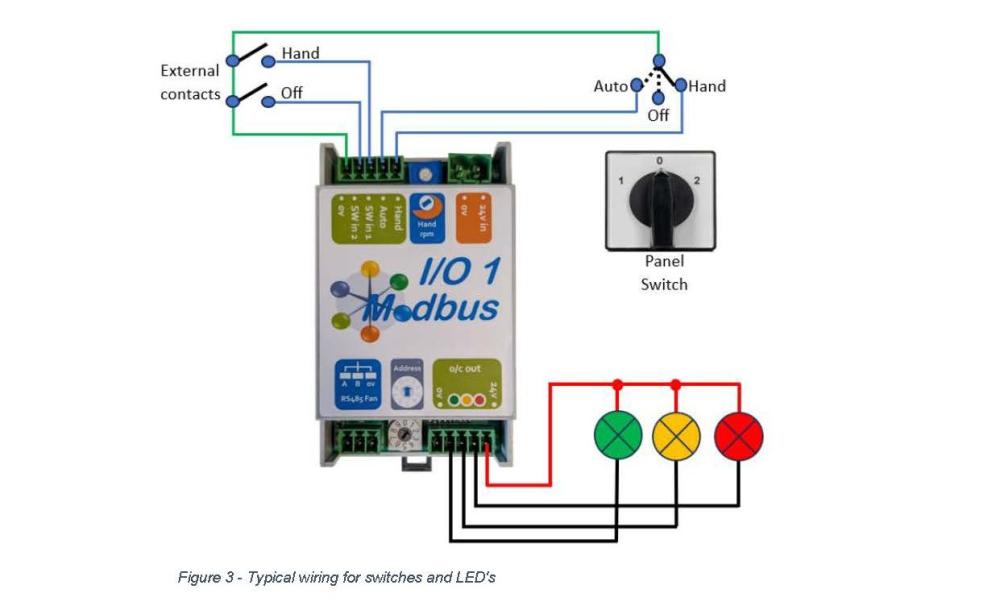
The CN1132 is split into two control groups. Each group can control a bank of fans independently via the Auto/Hand/Off toggle:
- Auto – fans are governed by the MMCU control logic (e.g. constant pressure, fixed speed, or proportional control
- Hand – fans are forced into a predefined manual output regardless of MMCU commands
- Off – fans are disabled (e.g. for maintenance or shutdown)
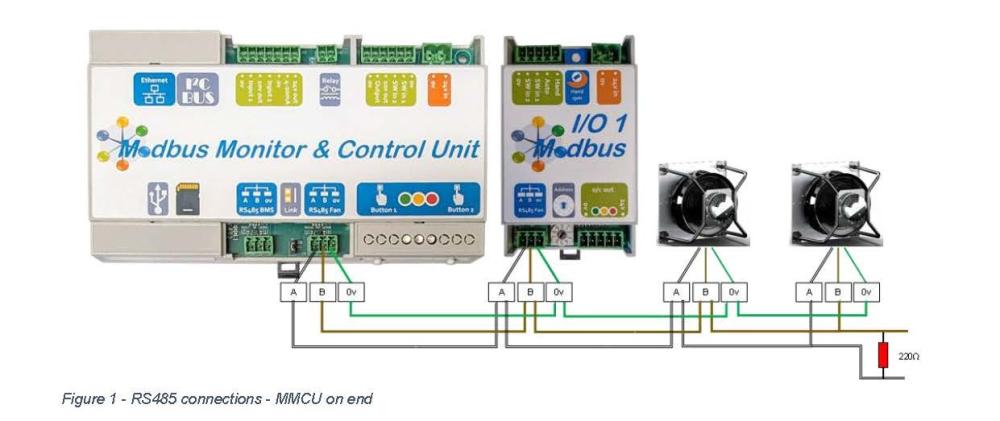
The module connects to the MMCU using Modbus over a simple 2-wire RS485 network. This allows:
- Low-voltage control
- Seamless communication with EBM Papst Insights Dashboard (if using CN1127/CN1133)
- Remote monitoring and override from connected HMI panels or the cloud
Video Demonstration Highlights

A recent walkthrough filmed at EBM Papst’s UK headquarters highlights key functionality:
- Switching from Auto to Hand triggers an immediate speed-up of the fan — verifying manual control.
- Off mode stops the fan while maintaining Modbus communication.
- When returning to Auto, the fan resumes normal control as dictated by the MMCU.
- The split-group design was demonstrated by isolating one group while maintaining control over the second — ideal for dual AHU fan decks or supply/extract pairings.
- Fan RPM feedback and mode status were visible in real-time, validating operational changes without needing to access a laptop.
Why Choose the CN1132 Over Competitor Options?
1. Low-Voltage Safety
Unlike many traditional Auto/Hand switches that use 230 V signals, the CN1132 operates entirely at low voltage — enhancing electrical safety within control panels and eliminating the need for voltage interlocks.
2. Integrated System Design
The CN1132 is designed by EBM Papst specifically for their MMCU and EC fan architecture. That means seamless compatibility, plug-and-play integration, and zero need for custom programming.
3. Modbus Native
Many third-party hand/off modules rely on hardwired IO. CN1132 uses Modbus RS485, ensuring reliable two-way communication and reducing cable runs.
4. Visual Feedback and Diagnostics
While some competitor modules offer switch control only, the CN1132 includes LED indicators for system health, warnings, and critical alarms — a powerful feature for service personnel.
5. Compact DIN-Mountable Design
It fits easily within standard AHU control panels, and its modular size allows it to be installed next to the MMCU or on separate DIN rail without taking up excessive space.
Who Should Use the CN1132?
- AHU manufacturers looking to offer flexible, service-friendly fan control
- Commissioning engineers needing safe, manual override options
- Service contractors performing fault investigation or maintenance
- Facility managers wanting local control over fan systems
- Installers integrating fire alarm input signals to stop or override fans
Installation Tips
- Mount the module near the MMCU in the control panel
- Use shielded twisted-pair cable for RS485 Modbus wiring
- Ensure group separation is clearly labelled for service engineers
- Test each fan group individually using Hand mode before going live
- Combine with CN1127 Ethernet MMCU or CN1133 NB-IoT MMCU modules for advanced control integration
Order the CN1132 from iACS
We are an authorised distributor of EBM Papst products, including the CN1132 Auto/Hand/Off I/O Module and compatible MMCU components.
- Order the CN1132 Auto/Hand/Off I/O Module now
- Contact our team for advice, commissioning support, or full MMCU-based solutions
Conclusion: Simplicity Meets Smart Control
The EBM Papst CN1132 Auto/Hand/Off I/O Module offers robust, reliable, and technician-friendly fan control — whether for AHU commissioning, maintenance, or emergency override. It enables smarter control and diagnostics at a local level, while remaining fully integrated with the digital capabilities of the EBM Papst fan ecosystem.
For a safe, low-voltage, and intelligent solution that simplifies fan control — look no further than the CN1132.
Recent Posts
-
Smart Fan Control with EBM Papst IoT Modules & Gateways — Now Available at iACS
 January 22, 2026
 -
Simplify HVAC Configuration with the Rubix Controls Selection Tool
 December 12, 2025
 -
iACS Partners with EBM Papst: Expanding Our HVAC Parts Catalogue with Innovative Fan Control Solutions
 December 9, 2025
 -
Revolutionising AHU Quoting with Rubix: The Free HVAC Quotation Tool
 December 3, 2025
 -
Optimise Airflow Control with EBM Papst Differential Pressure Sensors at iACS
 November 14, 2025