
What Our Customers Are Saying
Complete Guide: What is an Air Handling Unit (AHU)
24
Sep
In HVAC systems, the Air Handling Unit (AHU) is the backbone of optimal indoor air quality and climate control. AHUs are engineered to provide ventilation, heating, cooling, and filtration to maintain comfortable and efficient indoor environments.
At iACS, we not only deliver insights but also supply every essential component needed to build or maintain an AHU through our online store. From sensors and actuators to humidifiers and inverter drives, you’ll find everything at the iACS Store.
Table of Contents
What is an Air Handling Unit (AHU)?
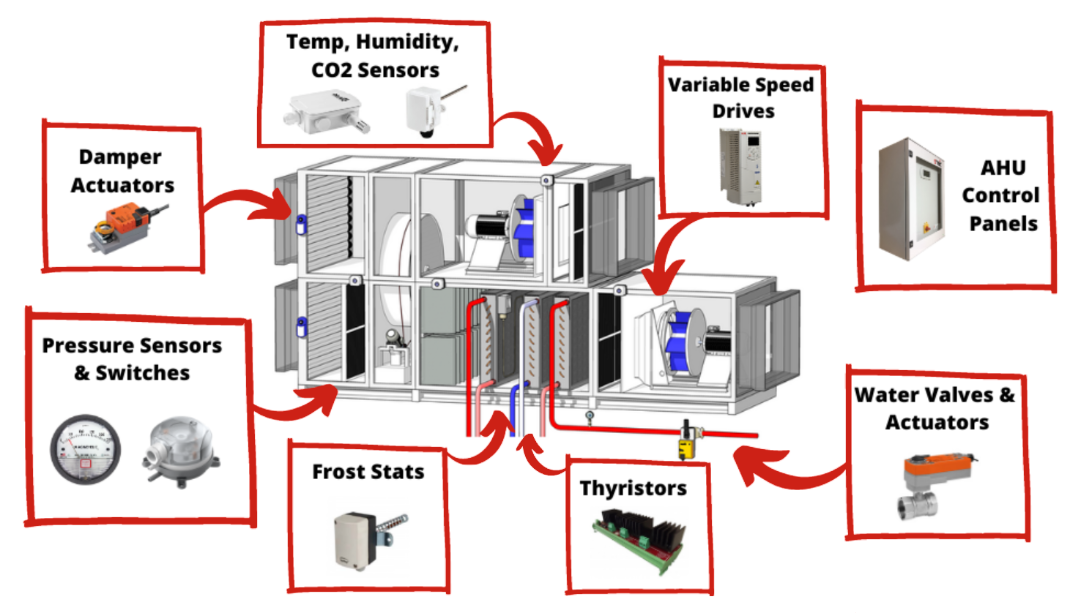
Essential Components of an AHU and Related Products
Detailed Comparison of AHU Components
FAQs About AHUs and Components
Sustainability and Energy Savings Tips for AHUs
Installation Tips for AHU Components
Why Shop for AHU Products at the iACS Store
What is an Air Handling Unit (AHU)?
An Air Handling Unit (AHU) is a centralised HVAC component designed to regulate and circulate air throughout a building. These systems are essential for ensuring a comfortable, healthy, and energy-efficient indoor environment.
AHUs are typically encased in metal housings and equipped with multiple components, including fans, filters, heating and cooling elements, and control systems. They condition air before it is distributed via ductwork across a building.
Additional Key Details:
- Modular Design: Many AHUs can be customised based on specific requirements by adding or removing sections such as heat recovery, filtration, or humidification units.
- Accessibility: Panels and sections are designed for easy maintenance and inspection, which minimises downtime and ensures system longevity.
Key Functions of an AHU
Ventilation: AHUs bring fresh air into the system and expel stale indoor air. This constant air exchange is crucial for maintaining a safe and breathable environment, particularly in commercial and industrial settings.
Filtration: Filters in the AHU remove contaminants like dust, pollen, and microorganisms. High-efficiency particulate air (HEPA) filters are commonly used in healthcare and pharmaceutical facilities to meet stringent air quality standards.
Temperature Regulation: AHUs incorporate heating and cooling coils that modify the temperature of the air being distributed. This is particularly critical in regions with fluctuating outdoor climates.
Humidity Control: Using humidifiers or dehumidifiers, AHUs maintain appropriate moisture levels in the air, which is vital for comfort, health, and the preservation of materials like wood or electronics.
Air Circulation: Fans within the AHU move air effectively throughout the building, ensuring even distribution and eliminating dead zones.
Thermal Comfort: AHUs not only regulate temperature but also improve thermal comfort by reducing the temperature differential within spaces.
Zoning: AHUs enable zoning within buildings, allowing specific areas to have individualised air control based on occupancy or operational needs.
Pressurisation: AHUs play a critical role in maintaining positive or negative pressure in spaces such as hospitals, laboratories, or cleanrooms.
Essential Components of an AHU and Related Products
1. PLC Controls: The Brain of the AHU
Product: Carel pCO Large PLC
- Details: This programmable logic controller (PLC) manages all operations within the AHU, such as fan speeds, temperature settings, and humidity control. It communicates seamlessly with
- Building Management Systems (BMS).
- Why Choose It?
Intuitive programming.
Handles complex configurations with ease.
Enhances system reliability.
2. Sensors: The Eyes and Ears of the System
Product: Belimo Duct Humidity and Temperature Sensor
- Details: This sensor measures temperature and humidity with precision, ensuring that the AHU adjusts performance as required.
- Why Choose It?
Delivers real-time data for optimal system adjustments.
Easy installation for various AHU setups.
3. Inverter Drives: Precision Energy Control
Product: ABB ACH580 Variable Frequency Drive
- Details: This inverter drive regulates fan speed, ensuring that the AHU only uses as much energy as necessary.
- Why Choose It?
Energy-efficient operation.
Reduces wear and tear on mechanical components.
4. Humidifiers: Essential for Comfort and Preservation
Product: Carel Humisteam X Plus Steam Humidifier
- Details: Provides precise humidity control, ideal for healthcare, manufacturing, and commercial environments.
- Why Choose It?
Durable and efficient design.
Easy to clean and maintain.
5. Water Valves: Fine-Tuned Temperature Control
Product: Belimo Energy Valve
- Details: Regulates the flow of hot or cold water through the coils for precise temperature adjustments.
- Why Choose It?
Advanced energy monitoring features.
Reduces energy wastage with precise flow control.
6. Actuators: The Workhorses of AHUs
Product: Belimo Rotary Actuator LR24A-MP
- Details: Controls dampers and valves for airflow regulation and temperature control.
- Why Choose It?
Compact design with reliable performance.
Compatible with various AHU configurations.
7. Heat Recovery Systems
What They Do: Heat recovery systems within AHUs recover thermal energy from exhaust air and use it to precondition incoming air. This is essential for improving energy efficiency.
Examples: Heat exchangers, thermal wheels, or run-around coil systems.
Why They Matter: They can recover up to 70–80% of the heat from outgoing air, significantly reducing energy consumption and operational costs.
While iACS does not currently list heat recovery systems in its inventory, they are a critical part of the AHU ecosystem, and iACS components like PLC controls and sensors are essential for monitoring and optimising these systems.
8. Filters (Expanded)
Key Details: Filters are not one-size-fits-all. Depending on the application, filters range from coarse filters (for removing larger particles) to HEPA or ULPA filters (for critical environments).
New Insight: Filters with ISO 16890 classification are becoming standard in commercial AHUs. Ensure your AHU design complies with these guidelines for improved air quality.
Detailed Comparison of AHU Components
|
Component |
Product |
Key Features |
Ideal Application |
|
PLC Control |
Reliable, programmable |
Advanced HVAC systems |
|
|
Sensors |
Accurate monitoring |
Healthcare and data centres |
|
|
Humidifiers |
Humidity control |
Offices, hospitals, and warehouses |
FAQs About AHUs and Components
How often should filters be replaced in an AHU?
Filters should be replaced every 3–6 months, depending on air quality.
Can iACS provide support for integrating AHU components?
Yes! Contact us for expert advice and installation services.
What is the role of dampers in an AHU?
Dampers regulate the volume and direction of airflow, critical for zoning and energy management.
Can I retrofit an older AHU with modern components?
Yes, components such as PLC controllers, inverter drives, and sensors can be retrofitted to improve the performance and energy efficiency of older AHUs.
5What materials are AHUs made of?
AHUs are typically constructed with galvanised steel, aluminium, or stainless steel for durability. Components, such as fans or coils, are often coated for corrosion resistance.
Sustainability and Energy Savings Tips for AHUs
1. Use Energy Recovery Systems: Heat exchangers recycle waste energy, reducing operational costs.
2. Install Inverter Drives: Regulate fan speeds for energy-efficient airflow control.
3. Upgrading Fans and Motors: High-efficiency motors paired with inverter drives (like the ABB ACH580) can reduce fan energy use by up to 30%.
4. Insulation: Ensuring AHUs have high-quality insulation minimises energy losses through the casing, especially for outdoor or rooftop units.
5. Leak Prevention: Proper sealing and gasket maintenance can prevent air leaks, which reduce efficiency and increase energy consumption.
6. Smart Controls: Leveraging iACS’s PLC controllers allows for advanced scheduling, zoning, and integration with renewable energy systems, further enhancing sustainability.
Installation Tips for AHU Components
Positioning and Clearance: Ensure AHUs are installed with adequate clearance for access to filters, fans, and dampers. This reduces maintenance time and costs.
Calibrate Sensors: Ensure accurate temperature and humidity measurements.
Secure Dampers and Valves: Properly align and tighten connections for smooth operation.
Duct Connections: Properly align and seal duct connections to avoid pressure drops and air leaks.
System Testing: Perform thorough commissioning after installation to test airflow, temperature control, and humidity levels.
Regular Maintenance Plan: Establish a maintenance schedule that includes cleaning filters, calibrating sensors, and inspecting energy recovery systems.
Contact iACS for Professional Installation Services: Our team ensures seamless component integration.
Why Shop for AHU Products at the iACS Store?
Shop at the iACS Store for every AHU and HVAC need. With high-quality products, expert support, and fast shipping, we are your trusted partner in the HVAC industry.
- Comprehensive inventory featuring PLC controllers, actuators, humidifiers, sensors, and more.
- Trusted partnerships with leading brands like Belimo, ABB, and Carel.
- Expert advice from iACS’s team to help you find the right solution for your specific AHU requirements.
Shop today at the iACS Store and find all your HVAC and AHU needs in one place.
Air Handling Units are essential for maintaining optimal indoor environments. With the right combination of components, AHUs can improve air quality, enhance energy efficiency, and support sustainability goals. Whether you’re designing a new AHU system or upgrading an existing one, iACS is your trusted partner for high-quality HVAC control solutions.
Visit the iACS Store today to explore our complete range of AHU control products and components, and contact us for information on our custom AHU control packages.
Comment(s)
Recent Posts
-
Smart Fan Control with EBM Papst IoT Modules & Gateways — Now Available at iACS
 January 22, 2026
 -
Simplify HVAC Configuration with the Rubix Controls Selection Tool
 December 12, 2025
 -
iACS Partners with EBM Papst: Expanding Our HVAC Parts Catalogue with Innovative Fan Control Solutions
 December 9, 2025
 -
Revolutionising AHU Quoting with Rubix: The Free HVAC Quotation Tool
 December 3, 2025
 -
Optimise Airflow Control with EBM Papst Differential Pressure Sensors at iACS
 November 14, 2025