


What Our Customers Are Saying
SKU
GK24A-MP
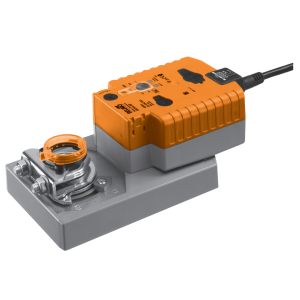
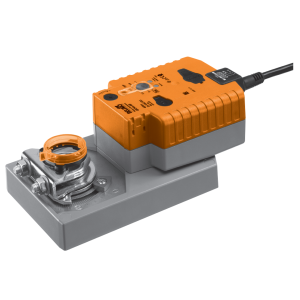
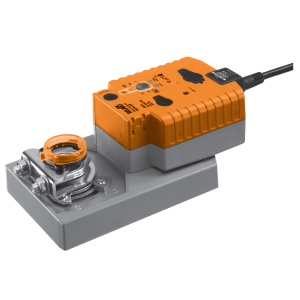
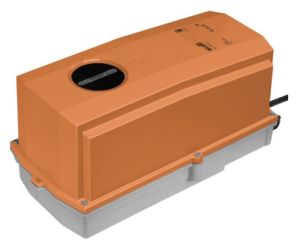
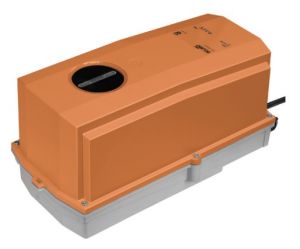
GK24A-MP POP Damper Actuator, 40 Nm, AC/DC 24 V, 150 s - Belimo
£735.84
£613.20
On request
Next Supplier Stock Update: 07/06/2026
Manuals & Datasheets
| DATASHEET |
 |
| Product type | Actuator |
| IP rating | IP54 |
| Input Signal | 0..10 Vdc, MP-BUS |
| Manufacturer | Belimo |
| Power Supply | 24Vac/Vdc |
| Torque | 40 Nm |
| Running time | 140 to 150 sec |
GK24A-MP POP Damper Actuator, 40 Nm, AC/DC 24 V, 150 s
- 40 Nm, 150 s adjustable, 95°
- AC/DC 24 V, modulating, MP-Bus
- Running time POP 35 s / 95°
- Power-Off position adjustable
- IP 54
- Operating range DC 2...10 V, 0...32 V adjustable
- Position feedback DC 2...10 V, 0...10 V adjustable
- Connection cable PVC 1 m
- Selectable direction of rotation (right/left)
- Spindle driver universal spindle clamp
Mode of operation: The actuator moves the damper to the desired operating position at the same time as the integrated capacitors are charged. Interrupting the supply voltage causes the damper to be rotated back into the emergency setting position (POP) by means of stored electrical energy. Conventional operation: The actuator is connected with a standard modulating signal of DC 0...10V and drives to the position defined by the positioning signal. Measuring voltage U serves for the electrical display of the damper position 0...100% and as slave control signal for other actuators. Operation on the MP-Bus: The actuator receives its digital positioning signal from the higher level controller via the MP-Bus and drives to the position defined. Connection U serves as communication interface and does not supply an analogue measuring voltage.
Pre-charging time (start up): The capacitor actuators require a pre-charging time. This time is used for charging the capacitors up to a usable voltage level. This ensures that, in the event of an electricity interruption, the actuator can move at any time from its current position into the preset emergency setting position (POP). The duration of the pre-charging time depends mainly on following factors: – Duration of the electricity interruption – PF delay time (bridging time)

Delivery condition (capacitors): The actuator is completely discharged after delivery from the factory, which is why the actuator requires approximately 20 s pre-charging time before initial commissioning in order to bring the capacitors up to the required voltage level.
Converter for sensors: Connection option for a sensor (passive or active sensor or switching contact). The MP actuator serves as an analogue/digital converter for the transmission of the sensor signal via MP-Bus to the higher level system.
Parameterisable actuators: The factory settings cover the most common applications. Single parameters can be modified with the Belimo Service Tools MFT-P or ZTH EU.
Simple direct mounting: Simple direct mounting on the damper spindle with an universal spindle clamp, supplied with an anti-rotation device to prevent the actuator from rotating.
Manual override: Manual control with push-button possible - temporary. The gear is disengaged and the actuator decoupled for as long as the button is pressed.
High functional reliability: The actuator is overload protected, requires no limit switches and automatically stops when the end stop is reached.
Home position: The first time the supply voltage is switched on, i.e. at the time of commissioning, the actuator carries out a synchronisation. The synchronisation is in the home position (0%). The actuator then moves into the position defined by the positioning signal.
Direction of rotation switch: When actuated, the direction of rotation switch changes the running direction in normal operation. The direction of rotation switch has no influence on the emergency setting position (POP) which has been set.
Adaption and synchronisation: An adaption can be triggered manually by pressing the “Adaption” button or with the PC-Tool. Both mechanical end stops are detected during the adaption (entire setting range). Automatic synchronisation after pressing the gearbox disengagement button is configured. The synchronisation is in the home position (0%). The actuator then moves into the position defined by the positioning signal. A range of settings can be adapted using the PC-Tool (see MFT-P documentation)
Emergency setting position (POP) rotary knob: The «Emergency setting position» rotary knob can be used to adjust the desired emergency setting position (POP) between 0 and 100% in 10% increments. The rotary knob refers only to the adapted angle of rotation range between 30 and 95°. No set Min or Max values are observed. In the event of a electricity interruption, the actuator will move into the selected emergency setting position (POP), taking into account the bridging time that has been set. Settings: The rotary knob must be set to the «Tool» position for retroactive settings of the emergency setting position (POP) with the Belimo service tool MFT-P. Once the rotary knob is set back to the range 0…100%, the manually set value will have positioning authority
Bridging time: Electricity interruptions can be bridged up to a maximum of 10 s. In the event of an electricity interruption, the actuator will remain stationary in accordance with the set bridging time. If the electricity interruption is greater than the set bridging time, then the actuator will move into the selected emergency setting position (POP). The bridging time set ex-works is 2 s. This can be modified on site in operation with the use of the Belimo service tool MFT-P. Settings: The rotary knob must not be set to the “Tool” position! For retroactive adjustments of the bridging time with the Belimo service tool MFT-P or with the ZTH EU adjustment and diagnostic device only the values need to be entered.
Electrical data:
- Nominal voltage AC/DC 24 V
- Nominal voltage frequency 50/60 Hz
- Nominal voltage range AC 19.2...28.8 V / DC 21.6...28.8 V
- Power consumption in operation 11 W
- Power consumption in rest position 3 W
- Power consumption for wire sizing 21 VA
- Power consumption for wire sizing note Imax 20 A @ 5 ms
- Connection supply / control Cable 1 m, 4 x 0.75 mm²
- Parallel operation Yes (note the performance data)
Functional data:
- Torque motor Min. 40 Nm
- Positioning signal Y DC 0...10 V
- Positioning signal Y note Input impedance 100 kΩ
- Control signal Y variable Open-close, 3-point (AC only) and modulating (DC 0...32 V)
- Operating range Y DC 2...10 V
- Operating range Y variable Start point DC 0.5...30 V and End point DC 2.5...32 V
- Position feedback U DC 2...10 V
- Position feedback U note Max. 0.5 mA
- Position feedback U variable Start point DC 0.5...8 V and End point DC 2.5...10 V
- Setting emergency setting position (POP) 0...100%, adjustable in increments of 10% (POP rotary knob on 0 corresponds to left end stop)
- Setting emergency setting position (POP) variable 0...100%, adjustable
- Bridging time (PF) 2 s
- Bridging time (PF) variable 0...10 s
- Position accuracy ±5%
- Direction of motion motor Selectable with switch 0 / 1
- Direction of motion note Y = 0 V: At switch position 0 (ccw rotation) / 1 (cw rotation)
- Direction of motion variable Electronically reversible
- Direction of motion emergency control function Selectable with switch 0...100%
- Manual override Gear disengagement with push-button
- Angle of rotation Max. 95°
- Angle of rotation note can be limited on both sides with adjustable mechanical end stops
- Running time motor 150 s / 90°
- Motor running time variable 90...150 s
- Running time emergency control position 35 s / 90°
- Running time emergency setting position note< 35 s @ 0...50°C
- Adaption setting range manual
- Adaption setting range variable No action, adaption when switched on adaption after pushing the gear disengagement button
- Override control MAX (maximum position) = 100%, MIN (minimum position) = 0% and ZS (intermediate position, AC only) = 50%
- Override control variable MAX = (MIN + 32%)...100%, MIN = 0%...(MAX – 32%) and ZS = MIN...MAX
- Sound power level motor 52 dB(A)
- Sound power level emergency control position 61 dB(A)
- Spindle driver Universal spindle clamp reversible 12...26.7 mm
- Position indication Mechanically, pluggable
Safety:
- Protection class IEC/EN III Safety extra-low voltage
- Protection class UL UL Class 2 Supply
- Degree of protection IEC/EN IP54
- Degree of protection NEMA/UL NEMA 2, UL Enclosure Type 2
- EMC CE according to 2004/108/EC
- Certification IEC/EN IEC/EN 60730-1 and IEC/EN 60730-2-14
- Certification UL cULus according to UL 60730-1A, UL 60730-2-14 and CAN/CSA E60730-1:02
- Mode of operation Type 1.AA
- Rated impulse voltage supply / control 0.8 kV
- Control pollution degree 3
- Ambient temperature -30...50°C
- Non-operating temperature -40...80°C
- Ambient humidity 95% r.h., non-condensing
- Maintenance Maintenance-free
Weight: 2.0 kg
Terms Abbreviations: POP = Power off position / emergency setting position PF = Power fail delay time / bridging time
Customers Also Bought